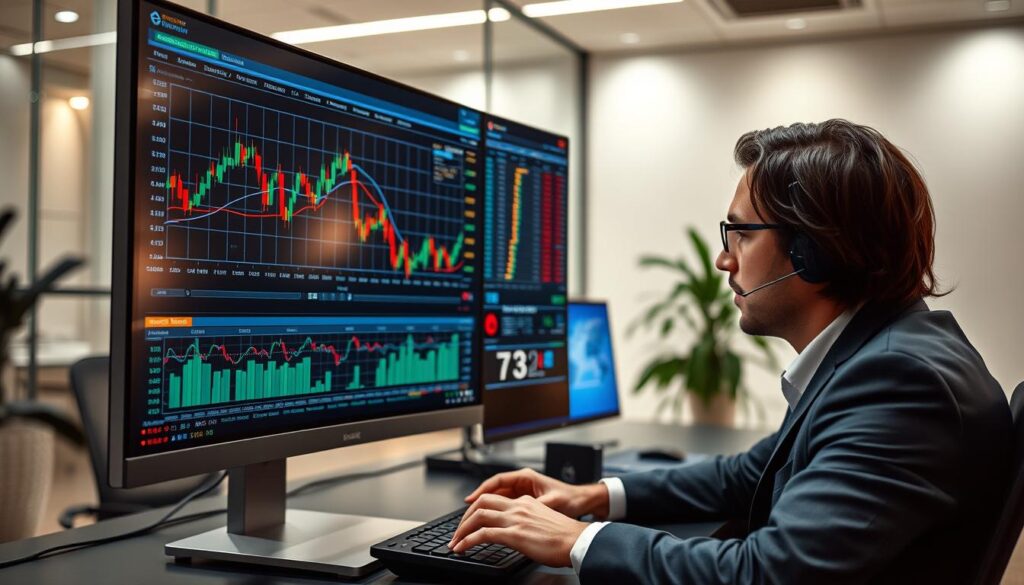
Entering the world of financial markets can be daunting for newcomers. A simulated trading platform offers a powerful solution. It lets people test their strategies in conditions that mirror real-life volatility without any financial risk.
This practice method is often called a virtual account. It provides a safe space to build confidence. Users can learn the mechanics of order execution and position management before using real capital.
Many professional traders credit their early success to this kind of rehearsal. Mastering technical analysis in a risk-free environment is a crucial first step. It transforms theoretical knowledge into practical skill.
This guide explores how to utilize a professional platform effectively. It will help you identify the right tools to begin your journey. The goal is to build a foundation for consistent and informed decision-making in volatile markets.
Overview of Simulated Trading and Its Benefits
Mastering market mechanics without financial exposure is a core advantage of modern practice platforms. This approach is integral for newcomers learning the ropes and seasoned professionals testing new concepts.
A simulated trading environment serves as a vital validation tool. It allows individuals to test their methods before committing real capital. The simulator mirrors actual price movements and volatility.
Using a virtual account provides valuable, risk-free experience. Many who refine their approach through practice see better long-term market results. This process builds the discipline needed for live activity.
A well-structured practice account helps prove a strategy’s profitability. Traders can focus on a consistent method over several weeks. This foundation supports more informed and confident decisions when transitioning to real funds.
What is Free Futures Paper Trading?
This specialized simulator replicates the conditions of real exchanges for futures contracts without any capital at stake. Often called demo trading, it is a tool for practicing buy and sell decisions using simulated money.
The system meticulously tracks every order and open position. This gives users a clear, real-time view of how their chosen method performs. They can see potential profits or losses as if they were in the live market.
This practice environment is not limited to one asset class. Individuals can explore forex, crypto, or futures to learn the unique rules for each. Understanding these differences is a key step toward informed participation.
The platform provides access to advanced chart types, indicators, and drawing tools. These resources help people analyze price action and test technical theories. It’s a complete sandbox for financial experimentation.
Developing a personal strategy is crucial here. The simulator allows one to refine an approach that matches their risk tolerance and goals. This rehearsal builds the discipline needed for eventual success with real funds.
Advantages of Paper Trading for New and Experienced Traders
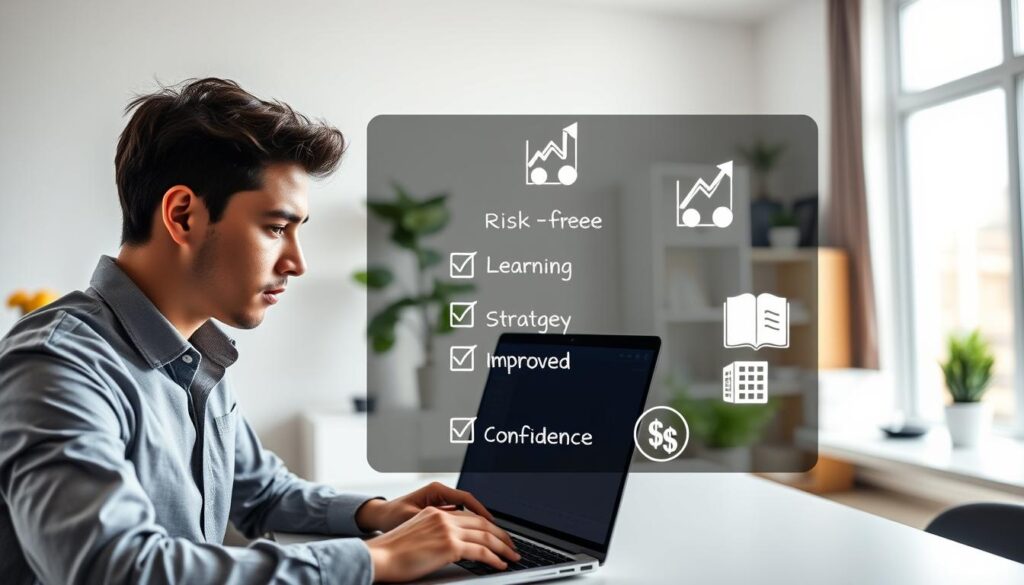
A practice simulator provides a crucial bridge between theoretical knowledge and real-world application for all market participants.
Technical and fundamental analysis offer powerful tools, but they often contradict each other. This environment lets people experiment with different methods to see how their ideas perform.
Newcomers benefit greatly. They learn the basics of platform navigation and order execution without the fear of losing their initial capital. This builds essential skills in a completely safe setting.
Seasoned traders use these tools to test complex strategies. They refine their technical analysis before applying concepts to a live brokerage account. This validation step is vital for consistency.
Markets are incredibly complex. Testing ideas in a simulator helps individuals identify which methods work best under specific conditions.
You can experiment with custom indicators across various asset classes. Consistent practice in a risk-free setting builds the confidence needed for a successful transition. It turns uncertainty into educated decision-making.
Setting Up Your Paper Trading Account: Step-by-Step Guide

Getting started with a simulated profile is a straightforward process that unlocks a world of practice opportunities. The first step involves locating the trading panel on your chosen platform.
Activating Your Account and Connecting to Platforms
To activate your demo environment, navigate to the trading panel at the bottom of the Supercharts. Click the connect button to initiate the virtual setup.
Your new practice profile usually begins with a substantial balance of $100,000 in simulated currency. This allows for extensive experimentation without real financial exposure.
The integrated manager lets you monitor all orders and open positions in real time. This provides full control over your simulated activity.
Customizing Account Settings and Leverage Options
You can tailor your profile settings to match your learning goals. Adjusting leverage ratios is a key feature.
For instance, you might set it to 20:1 for futures or 50:1 for forex. This customization helps replicate specific market conditions.
If you wish to test a new approach, the system allows a reset of your balance. You can also create multiple separate profiles on the same platform.
This enables simultaneous testing of different strategies under identical market conditions. It is a powerful way to compare methods side-by-side.
Navigating the Trading Panel and Order Types

The command center for any market activity is the trading interface where decisions become actions. This panel serves as the central hub for submitting instructions, monitoring open positions, and tracking overall account performance.
How to Place Orders Using the Order Panel
To execute a decision, you first select the asset within the panel. Next, choose the type of instruction you wish to submit and specify the quantity.
Finally, you confirm the transaction to send it to the system. This process is where your strategy meets the market.
Understanding Market, Limit, and Stop Orders
Different instruction types give you control over entry and exit points. A market order is executed instantly at the best available price.
It ensures your trade is filled immediately during active hours. A limit order requires you to set both the number of units and your desired price.
This instruction may not get filled if market liquidity is low. Stop orders are submitted to the system and only trigger once the asset reaches your defined price level.
They are essential tools for managing potential losses effectively.
Essential Charting Tools and Technical Analysis for Simulated Trading

A robust set of analytical instruments is fundamental for anyone learning to navigate market movements effectively. Technical analysis is a comprehensive study that may take time to learn. Mastery begins with understanding how to use various metrics and visual aids.
Utilizing Indicators and Drawing Tools for Analysis
You can apply various indicators and drawing tools to your charts. These resources help identify trends and potential entry points. Moving averages and RSI are common examples used for this type of analysis.
The ability to scrutinize price action directly from the chart is powerful. It helps people make informed decisions before they place orders. This visual approach turns complex data into clear, actionable signals.
Many platforms offer sophisticated charting software. It allows users to scan and track setups using a wide range of technical indicators. Consistent use of these analytical tools builds a deeper understanding of asset behavior.
Different assets react uniquely to changing market conditions. Practicing with these charting tools in a simulated environment is invaluable. It prepares individuals for the dynamic nature of live trading.
Building Effective Trading Strategies in a Risk-Free Environment

A robust methodology is forged not in live markets, but within the safety of a virtual environment. This practice space allows individuals to develop a unique approach that matches their personal style and stress tolerance. It is where theoretical concepts transform into actionable plans.
Developing, Testing, and Refining Your Strategy
Creating a durable market plan requires systematic validation. People should test their ideas in a simulator until they see consistent results over time. This process helps identify what works under various conditions.
Documenting every decision in a journal is crucial. Reviewing this history allows for precise refinements. The goal is to build a strategy that performs reliably across different market phases.
Many platforms provide analytical tools and let users export their activity data as a CSV file. This enables detailed quantitative analysis. A high-performance backtesting engine can simulate automated plans on historical information to assess past performance accurately.
This rigorous development cycle builds the confidence needed to handle real-world volatility. A strategy proven in simulation provides a solid foundation for eventual live participation.
Exploring Top Platforms for Paper Trading

With numerous options available, evaluating the leading simulators can streamline your learning process. Each software solution offers a unique blend of features and tools designed for different goals.
Comparing Features, Tools, and User Experiences
Interactive Brokers is a top choice for many active participants. Its practice account provides a massive $1 million in virtual funds across over 170 global markets.
NinjaTrader is built specifically for futures simulation. It offers professional-grade tools and a 14-day trial with livestreaming data.
ProRealTime offers unlimited access to its web-based simulator. This French company serves over a million users worldwide.
cTrader, developed by Spotware, is popular with forex traders. It provides fast execution and deep market visibility.
Thinkorswim delivers institutional-quality analysis tools. It manages over a trillion in assets but has a steeper learning curve.
XTB provides a clean demo on its xStation 5 platform. Note that this account closes after 30 days of inactivity.
Choosing the right platform depends on your asset focus and desired features. These brokers provide excellent environments for honing your skills.
Practical Insights and Tips for Successful Paper Trading

The true value of a simulated environment emerges not during the activity, but in the careful review that follows. This disciplined approach separates those who merely practice from those who genuinely improve. Treating every virtual transaction with the same seriousness as a live one is the cornerstone of effective learning.
Your practice account generates a wealth of information. The trading journal displays textual details about every order and its exact timing. This log is a crucial tool for understanding your decision-making process.
Learning from Trade History and Simulated Journals
Meanwhile, the account history provides a clear record of all closed positions. It shows entry prices and the realized profit and loss for each. Reviewing this data allows you to see how your results align with your initial strategy.
Maintaining a detailed journal is one of the best ways to learn from your history. Analyzing past data helps identify recurring mistakes. This process is essential for refining your approach before entering live markets.
Consistent review of your simulated journals builds a reliable method over time. It transforms raw experience into actionable insight. This habit ensures you are truly prepared for real-world conditions.
Advanced Backtesting and Simulation Techniques

Sophisticated backtesting engines unlock a deeper layer of market preparation by analyzing historical performance. Platforms like NinjaTrader allow you to simulate automated strategies on years of past data. This process checks if a plan is robust and reliable across different economic cycles.
A powerful feature is market replay. You can watch historical sessions tick by tick, fully synchronized across your platform. It lets you practice your reactions as if the market were live, honing your execution timing.
These simulation tools provide analysis far beyond standard paper trading. They help you prepare for various market scenarios you might not encounter in a basic simulator.
By controlling the data feed, you test how strategies perform under specific conditions. You can then refine your logic accordingly. Mastering these advanced tools builds a significant edge for live trading.
Final Takeaways on Mastering Simulated Futures Trading
True proficiency in any financial simulator is measured by the consistency of results and the depth of learning extracted. This journey requires patience and a commitment to refining your unique approach.
The core goal of using a practice platform is to prove a method’s viability. By utilizing analytical tools and studying performance data, you build a reliable set of strategies before risking capital.
Consistent success in your demo account is the best preparation for live market conditions. It builds the discipline needed for informed decision-making.
We wish you great success as you continue to learn and grow your skills. Mastering paper trading is a powerful step toward confident participation.