
Entering the financial markets can feel daunting. A futures paper trading account offers a powerful solution. It is a simulated environment where individuals can practice their methods without using real capital.
This type of practice platform lets investors test their skills under near-real scenarios. They can build essential confidence before moving to live markets. The emotional pitfalls of using actual money are completely avoided.
Users gain valuable experience with various asset classes. They learn how different strategies perform in shifting market conditions. This hands-on approach is a critical step for anyone serious about investing.
The platform itself comes with a comprehensive suite of tools. These features are designed to mimic real-world dynamics closely. Understanding the pros and limitations of this approach is key for long-term success.
Understanding the Basics of a Futures Paper Trading Account
Before risking actual capital, savvy investors often turn to simulation. This practice, known as paper trading, is a digital evolution. It moves beyond tracking hypothetical deals with pencil and paper.
What is Paper Trading and Its Role in Market Simulation
A demo account like the RJO Futures Demo Account is a popular example. It lets people place orders and track positions with virtual money. This creates a near-identical replica of real market dynamics.
Users gain access to the same professional tools found on a live trading platform. The core role is to provide a risk-free sandbox. Here, one can learn the mechanics of different asset classes.
Differences Between Paper Trading and Real Money Trading
The most significant contrast is psychological. Without real financial stakes, emotional decision-making is removed. This allows for clear, objective analysis of methods.
Another key distinction is the consequence of error. Mistakes in a simulated environment are learning opportunities, not losses. This freedom encourages more rigorous testing of various approaches.
The experience is invaluable for building confidence. By keeping accurate records, individuals see how their plans perform over time. This foundational step is crucial before funding a live account.
Key Features and Tools for a Successful Experience
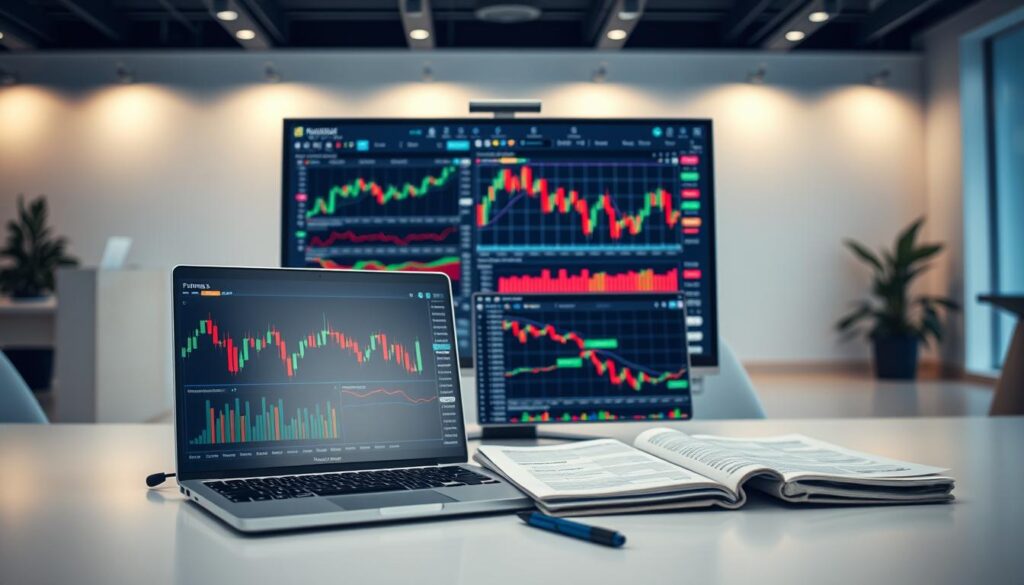
The true power of a practice platform is unlocked through its integrated tools and data feeds. These components transform a simple simulation into a rich learning environment.
Overview of the Trading Panel and Order Systems
The trading panel acts as the central command hub. Here, users configure settings, track all active orders, and manage open positions with precision.
Executing a deal is streamlined. One can place an order directly from a price chart or use a detailed ticket. This flexibility supports testing various entry and exit tactics.
Leveraging Chart Tools and Market Data
Technical analysis is a cornerstone of informed decision-making. The platform provides access to major studies like moving averages, RSI, and DMI.
These indicators and drawing tools help visualize trends and momentum. They are essential for identifying potential entry and exit points under different conditions.
Successful use of a demo environment requires understanding how these tools interact with live market data. This deep study builds the analytical skill needed for live markets.
Setting Up Your Futures Paper Trading Account

Activating a demo environment involves a few simple steps that unlock its full potential. This process tailors the simulation to match an individual’s specific learning goals and preferred market conditions.
How to Activate and Configure Your Demo Account
Registration is typically quick. Upon completion, the system automatically credits the user with a substantial amount of simulated capital.
This initial balance, often set at $100,000 in virtual funds, provides ample room to experiment with various methods. The user can then access the account manager to fine-tune the experience.
Key configuration options include selecting which real-time data feeds to display and which order types are active on the charts. This ensures the platform reflects the tools one would use with real capital.
Customizing Leverage, Commissions, and Account Settings
Leverage is a powerful feature that can be adjusted. Defaults are often set to mimic industry standards, such as 20:1 for futures contracts or 50:1 for forex pairs.
Changing these multipliers allows a person to test how different levels of borrowed capital affect potential outcomes and risk. The commission structure can also be modified per contract to mirror real-world brokerage costs.
Further personalization is possible through the settings menu, accessible via a gear icon. Here, users can reset their balance to the original amount or select their preferred currency from over twenty global options.
This level of detail in the setup phase is crucial. It creates a robust sandbox for developing and refining a personal approach without financial pressure.
Exploring the “Futures Paper Trading Account” in Practice

Mastering the mechanics of order execution is a fundamental skill for any market participant. This section delves into the practical application of a simulated environment.
It focuses on two critical areas: executing transactions and monitoring outcomes.
Placing Orders: Market, Limit, and Stop Types
Understanding the distinction between order types is essential. A market order is filled immediately at the current best available price.
This guarantees swift execution during active sessions. A limit order only executes when the asset reaches a specific price set by the user.
It provides control over entry and exit points. A stop order is submitted after a defined level is reached. This is often used to manage risk.
Tracking Trades, Positions, and Account History
The platform’s dedicated tabs let users monitor all open positions and past activity. The account manager supplies detailed data on profits and losses.
This information helps evaluate the success of various methods. Reviewing historical activity identifies which assets work best for one’s personal approach.
Practicing fund and margin management in this risk-free setting builds critical skills for live markets.
Pros, Benefits, and Navigating Limitations

The journey from practice to live execution is paved with both clear benefits and subtle pitfalls. Understanding these aspects helps users maximize their learning in a simulated environment.
Risk-Free Experimentation and Strategy Testing
The most significant advantage is the freedom to experiment. Individuals can test various methods across different assets without fear of loss.
Platforms like The Leap competition enhance this. They allow participants to compete globally for real-money prizes. This adds a layer of motivation while still using simulated funds.
Potential Drawbacks and How to Overcome Them
A key limitation is the absence of real financial pressure. This can sometimes lead to overly aggressive behavior that wouldn’t be sustainable with actual capital.
To overcome this, treat the simulator with the same seriousness as a live platform. Effective habits include:
- Setting and adhering to personal risk limits.
- Keeping detailed records of all decisions.
- Analyzing both winning and losing outcomes thoroughly.
Integrating Real-Time Data and Sophisticated Tools
Using live market data and advanced analytical tools is crucial. This integration provides a realistic feel for price movements and volatility.
It helps users gain a competitive edge before committing real funds. Remember, while the simulator itself has no fees, real-world platforms include costs for every order.
This hands-on experience is a vital part of a long-term learning journey.
Final Thoughts on Your Simulated Trading Journey
A simulated environment provides the ultimate training ground for developing the discipline required for live market participation. This foundational journey turns theoretical knowledge into practical experience.
By consistently using the tools and real-time data on your platform, you build the confidence to navigate complex conditions. Refining your strategies and monitoring positions here is invaluable practice.
Remember, repetition builds skill. The time invested in a demo setting pays dividends. Keep detailed records of all decisions to learn from every outcome.
This prepares you thoroughly for the next step. We wish you success as you continue to master the craft.


